Markets move fast, but smart money moves with clarity. Behind every sharp rally or sudden crash lies a pattern—signals hidden in data that experienced investors quietly follow while others react too late. The difference between guessing and making informed decisions often comes down to how well you read these signals.
A Market Indicator acts as that guiding layer, helping traders and investors decode price action, sentiment, and momentum in real time. In today’s high-volatility environment, driven by global cues and rapid capital flows, relying on instinct alone is no longer enough. At Dhanvitra, we see a clear shift toward structured, data-backed decision-making where understanding indicators is becoming a core skill, not an optional edge.
Consider how seasoned traders track the VIX index during uncertain phases or monitor the fear and greed index to gauge market sentiment before entering positions. Others rely on forex trading signals or volume-based insights to confirm trends before committing capital. Whether it’s a retail investor adjusting a portfolio during market volatility or an intraday trader reacting to sudden spikes, these tools shape real-world financial decisions every day.
This guide breaks down how to use each Market Indicator with clarity and purpose—without overcomplication or noise. You’ll learn how to identify reliable signals, avoid common traps, and build a smarter framework for trading and investing decisions that actually hold up in real market conditions.
Why beginners fail without understanding indicators
Many beginners enter the market with excitement but without a clear understanding of how price movements actually work. They often rely on tips, social media trends, or random trades without realizing that markets are driven by data, sentiment, and structured analysis. This is where a Market Indicator becomes essential. Without it, trading decisions are mostly guesswork, which leads to inconsistent results and avoidable losses over time.
A common mistake new traders make is ignoring how stock market indicators and market sentiment indicators reflect the real-time behavior of buyers and sellers. For example, when fear dominates the market, prices may fall even if fundamentals look strong. Beginners who don’t track tools like the fear and greed index often misread such situations and enter or exit trades at the wrong time. Understanding these signals helps traders align their decisions with the broader market mood instead of reacting emotionally.
Another reason beginners struggle is the lack of a structured approach. They might hear about popular tools like RSI or moving averages, but don’t understand when or why to use them. Indicators are not magic tools—they require context, discipline, and consistency. Without this, even the best tools can lead to confusion rather than clarity.
Ultimately, the gap is not intelligence but awareness. Once beginners start using indicators properly, they move from emotional decisions to informed strategies. This shift is what separates short-term losses from long-term growth in trading.
What is a Market Indicator?
A Market Indicator is a tool or data point that helps traders and investors understand the current condition of the market and predict possible future movements. It simplifies complex market data into signals that are easier to interpret. Whether you are trading stocks, forex, or indices, indicators act as a guide to help you make more informed decisions rather than relying on instinct alone.
At its core, an indicator processes price, volume, or economic data to reveal patterns. For example, technical indicators in stock market analysis use historical price movements to identify trends, while economic tools like leading economic indicators provide insight into broader financial conditions. Together, they create a clearer picture of where the market might be heading.
It is also important to understand that not all indicators serve the same purpose. Some are designed to predict future movements, while others confirm trends that have already started. For instance, tools like moving averages help identify ongoing trends, whereas sentiment tools like the market mood index show whether traders are feeling optimistic or fearful. Knowing the difference helps avoid confusion and improves decision-making.
In real-world trading, indicators work best when used as part of a system rather than in isolation. A trader might combine price action with one or two indicators to confirm signals. This balanced approach keeps analysis simple while still being effective, especially for those building consistency in their trading journey.
Types of Market Indicators You Must Know
Understanding different types of indicators is key to building a strong foundation in trading. Each type serves a unique purpose, and knowing when to use them can significantly improve your decision-making. Broadly, indicators can be grouped based on what they measure—price trends, momentum, sentiment, or economic conditions.
Technical indicators are the most commonly used tools among traders. These include moving averages, RSI, and other best stock indicators that help identify trends and entry points. They rely on historical price data and are widely used in both stocks and forex markets. Alongside these, tools like the money flow index and volume analysis help confirm whether a price movement is strong or weak, giving traders more confidence in their decisions.
Another important category is sentiment-based tools. These indicators measure how traders feel about the market. The fear and greed index is a popular example that reflects whether the market is driven by panic or optimism. Similarly, the market sentiment indicator helps traders anticipate potential reversals when emotions reach extreme levels. These tools are especially useful during volatile market conditions.
Finally, economic and institutional indicators provide a broader perspective. Data such as inflation, employment, and leading economic indicators influence long-term market direction. While they may not be used for quick trades, they are essential for understanding the bigger picture and aligning your strategy with overall market trends.
Understanding Volatility Indicators (VIX & Beyond)
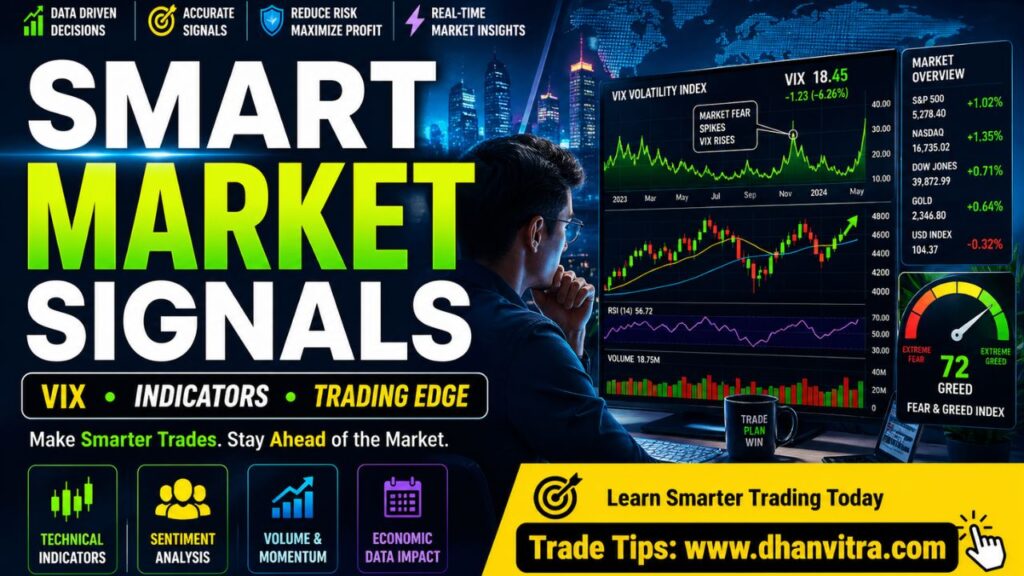
Volatility indicators help traders measure how much the market is expected to move, rather than the direction of that movement. Among these, the VIX index, also known as the CBOE Volatility Index, is one of the most widely followed tools. It is often referred to as the “fear gauge” because it rises when uncertainty and panic increase in the market.
The VIX index is derived from options pricing on major indices and reflects expected market volatility over the near term. When the VIX is low, it usually signals calm and stable conditions. On the other hand, a sharp rise in the VIX volatility index suggests that investors are preparing for potential market swings. Traders often monitor the VIX chart to understand whether the market is entering a risk-on or risk-off phase.
However, it’s important to avoid a common misconception. A rising VIX does not always mean prices will fall, but it does indicate increased uncertainty. This is why experienced traders use it alongside other tools, such as price trends and volume, to build a more complete view of the market.
Beyond the VIX, there are other volatility measures like sector-specific indices and global volatility tools. These can provide deeper insights into specific markets or regions. When used correctly, volatility indicators become a powerful part of any trading strategy, helping traders manage risk and prepare for sudden market changes rather than being caught off guard.
Market Sentiment Indicators Explained
Market sentiment is often the hidden force behind price movements. While charts and numbers tell one story, investor emotions tell another. This is where a Market Indicator focused on sentiment becomes powerful. It helps you understand whether the market is driven by fear, greed, optimism, or uncertainty. For everyday investors, this insight can make the difference between reacting late and acting early.
One of the most widely followed sentiment tools is the fear and greed index. It combines multiple data points like stock momentum, volatility, and demand for safe assets to show the overall market mood. When the index signals extreme fear, it often means prices may be undervalued. On the other hand, extreme greed can indicate overbought conditions. While it is not a perfect timing tool, it gives a useful context to support your decisions.
Another key sentiment measure is the VIX index, often called the “fear gauge.” The CBOE Volatility Index reflects expected market volatility based on options pricing. A rising VIX usually signals growing uncertainty, while a falling VIX suggests stability. Watching the VIX index chart alongside major indices can help you understand how confident or nervous investors really are.
They work best when combined with price action and fundamental analysis. For example, if the market is falling but sentiment shows extreme fear, it may hint at a potential reversal. Understanding these emotional cycles helps investors stay calm, avoid panic decisions, and act more strategically in real market conditions.
Best Technical Indicators for Smart Trading Decisions
Technical indicators are the backbone of modern trading strategies. They transform raw price data into meaningful insights that traders can act on. A well-chosen Market Indicator helps you identify trends, momentum, and potential entry or exit points without relying on guesswork. The key is not using too many tools, but choosing the right ones that fit your trading style.
The Relative Strength Index, commonly known as RSI forex, is one of the simplest yet effective indicators. It measures whether an asset is overbought or oversold. When RSI moves above a certain level, it may suggest prices have risen too quickly. When it drops too low, it could signal a buying opportunity. Many traders combine RSI with trend analysis to improve accuracy.
Moving averages are another essential tool. Whether it is a short-term setup or the best moving average for intraday, these indicators smooth out price fluctuations and help you see the bigger trend. For instance, when the price stays above a moving average, it often confirms an uptrend. When it falls below, it may indicate weakness. This simple concept is widely used across stocks, forex, and even index futures.
Volume-based tools like the money flow index add another layer of confirmation. They show whether price movements are supported by strong buying or selling activity. When price rises with increasing volume, the trend is usually stronger. By combining momentum, trend, and volume indicators, traders can make more informed decisions and reduce emotional trading mistakes.
Best Forex Indicators for Beginners and Pros
Forex trading moves fast, and having the right tools can make a significant difference. For both beginners and experienced traders, choosing the best forex indicator is less about complexity and more about clarity. A good indicator should simplify decision-making, not complicate it. In real-world trading, consistency matters more than chasing perfect signals.
One of the most practical tools is the forex strength meter. It helps traders understand which currencies are strong and which are weak at any given moment. Instead of analyzing pairs individually, this tool gives a broader view of the market. When paired with a forex currency strength meter, traders can spot high-probability trades by matching strong currencies against weak ones.
Another essential part of forex trading is understanding price behavior through forex candlestick patterns. These patterns reflect real market psychology. For example, rejection candles or engulfing patterns often signal potential reversals. When combined with price action forex strategies, they allow traders to make decisions based on actual market movement rather than lagging signals.
For those using platforms like MT4, built-in tools such as trend indicators and oscillators are widely used. Many traders rely on a mix of indicators to confirm signals rather than depending on just one. The goal is to build a simple, repeatable system that works in different market conditions. Over time, experience helps traders refine their approach and rely more on clarity than complexity.
How to Combine Indicators for Accurate Signals
Using a single indicator can provide useful insights, but relying on just one often leads to incomplete decisions. The real strength of a Market Indicator comes when it is combined thoughtfully with others. The idea is not to overload your chart but to create a balanced system where each tool serves a specific purpose.
A practical approach is to combine trend, momentum, and volume indicators. For example, a moving average can help identify the overall trend, while an RSI confirms whether the market is overextended. Adding stock volume or volume in trading ensures that the move is supported by real participation. This layered approach reduces the chances of false signals and improves confidence in your trades.
It is also important to avoid conflicting signals. Many beginners use multiple indicators that essentially show the same information in different forms. Instead, focus on complementary tools. For instance, pairing a market sentiment indicator like the fear and greed index with technical analysis can give both emotional and data-driven perspectives. This helps you understand not just what the market is doing, but why it might be doing it.
Building a simple trading system takes time, but it pays off in consistency. Start with two or three indicators, test them in real market conditions, and refine your approach gradually. The goal is not to predict every move but to improve decision-making over time. When used correctly, a combination of indicators can turn uncertainty into a more structured and disciplined trading process.
Real-World Examples of Market Indicators in Action
In real markets, a Market Indicator becomes truly valuable only when you see how it behaves during actual events. Take the VIX index, often called the fear gauge. During periods of uncertainty—like economic crises or sudden geopolitical tensions—the volatility index tends to spike sharply. This signals that traders are expecting larger price swings. For example, when the VIX rises above its normal range, it often reflects panic or caution in the market, even before stock prices fully react. Observing a VIX chart during such periods can help traders understand when risk is increasing.
Another practical example comes from combining technical indicators. Imagine a trader using the RSI alongside a moving average. If the RSI shows oversold conditions while the price touches a key moving average, it can signal a potential reversal. This is where a Market Indicator helps translate raw price data into actionable insights. Traders don’t rely on a single signal but look for confirmation across multiple tools to reduce risk.
In forex trading, indicators like a forex strength meter or basic forex candlestick patterns can guide entry and exit decisions. For instance, if a currency shows strong momentum across multiple pairs and aligns with bullish candlestick formations, traders may consider entering a trade. This is a common approach used alongside forex trading signals, especially for short-term strategies.
The key takeaway from these examples is simple: indicators are most powerful when used in context. Markets are dynamic, and no single tool can predict outcomes with certainty. But when you understand how different signals interact in real scenarios, you start making smarter, more confident decisions.
Common Mistakes Traders Make with Market Indicators
One of the most common mistakes traders make is overloading their charts with too many indicators. It often starts with good intentions—wanting more confirmation—but quickly turns into confusion. When you combine several stock market indicators without a clear strategy, you may end up with conflicting signals. Instead of clarity, you get hesitation. A well-used Market Indicator should simplify decisions, not complicate them.
Another frequent issue is blindly following signals without understanding the logic behind them. Many beginners treat indicators like automatic trading systems, expecting them to predict the market perfectly. For example, relying solely on a fear and greed index without considering broader conditions like economic data or market news can lead to poor decisions. Indicators reflect patterns, not guarantees.
Ignoring context is another costly mistake. Markets are influenced by multiple factors, including global events, interest rates, and liquidity. Even reliable tools like the market sentiment indicator or market volatility index can give misleading signals if used in isolation. For instance, a high volatility reading might signal risk, but it could also present an opportunity for experienced traders.
Finally, many traders fail to adapt their indicators to different timeframes. What works for intraday trading may not work for long-term investing. Using the same setup across all strategies often leads to inconsistent results. The real skill lies in understanding when and how to adjust your tools. A thoughtful approach always beats blindly chasing signals.
Advanced Insights: Institutional Indicators & Hidden Signals
Beyond common tools, experienced traders and institutions rely on deeper layers of analysis that go unnoticed by most retail participants. One such example is open interest analysis, especially in options and futures markets. Changes in open interest can reveal where large players are placing their bets. When combined with price movement, it can indicate whether a trend is gaining strength or losing momentum.
Another powerful yet underused area is market breadth. Indicators like the McClellan Oscillator help measure how many stocks are participating in a move, not just the index itself. This provides a clearer picture of overall market health. A rising index with weak breadth can signal underlying weakness. These types of market breadth indicators are often used by institutional investors to confirm trends.
Macro-level indicators also play a critical role. The Buffett Indicator, which compares total market capitalization to GDP, gives a broader view of whether markets are overvalued or undervalued. Similarly, tracking leading economic indicators such as employment data, inflation, or GDP growth helps traders align with the bigger picture rather than just short-term price action.
What makes these insights valuable is their ability to reveal hidden signals. While a basic Market Indicator might show what is happening on the surface, institutional tools help explain why it is happening. This deeper understanding allows traders to move from reactive decisions to more strategic thinking, which is essential for long-term success.
Conclusion: How to Start Using Market Indicators Smartly
Getting started with any Market Indicator does not require complex systems or advanced tools. In fact, the smartest approach is often the simplest one. Begin by choosing one or two indicators that are easy to understand, such as a moving average or RSI. Focus on learning how they behave in different market conditions instead of constantly switching tools. Consistency builds confidence over time.
It is also important to combine indicators with real-world context. Markets are influenced by news, economic data, and global trends. For example, keeping an eye on the fear and greed index alongside price movement can help you understand whether sentiment is driving the market. Similarly, watching the VIX index today gives you a quick snapshot of current volatility levels.
Practice plays a huge role in building skill. Instead of risking money immediately, spend time observing charts and testing strategies. Many traders use demo accounts or backtesting methods to refine their approach. This helps you understand how different signals behave without emotional pressure.
Ultimately, the goal is not to find a perfect indicator but to develop a disciplined process. A well-used Market Indicator acts as a guide, not a decision-maker. When combined with patience, risk management, and continuous learning, it becomes a powerful tool that supports smarter and more confident trading decisions.
Frequently Asked Questions
What is the best market indicator for beginners?
For beginners, simple tools like moving averages or RSI are often the best starting point. They are easy to understand and widely used, making them a reliable introduction to how a Market Indicator works in real trading conditions.
How does the VIX index predict market fear?
The VIX index measures expected volatility in the market. When it rises, it signals that traders expect bigger price swings, often driven by fear or uncertainty. It does not predict direction but reflects sentiment.
Can I rely only on indicators for trading?
No, indicators should not be used alone. They work best when combined with price action, market news, and overall context. Relying only on signals can lead to incomplete decisions.
Which indicator works best for intraday trading?
There is no single best tool, but many traders use RSI, moving averages, and volume-based indicators for short-term strategies. The key is finding what fits your approach.
Are forex indicators different from stock indicators?
The core concepts are similar, but forex traders often rely more on tools like forex trading signals and currency strength indicators due to the nature of the market.