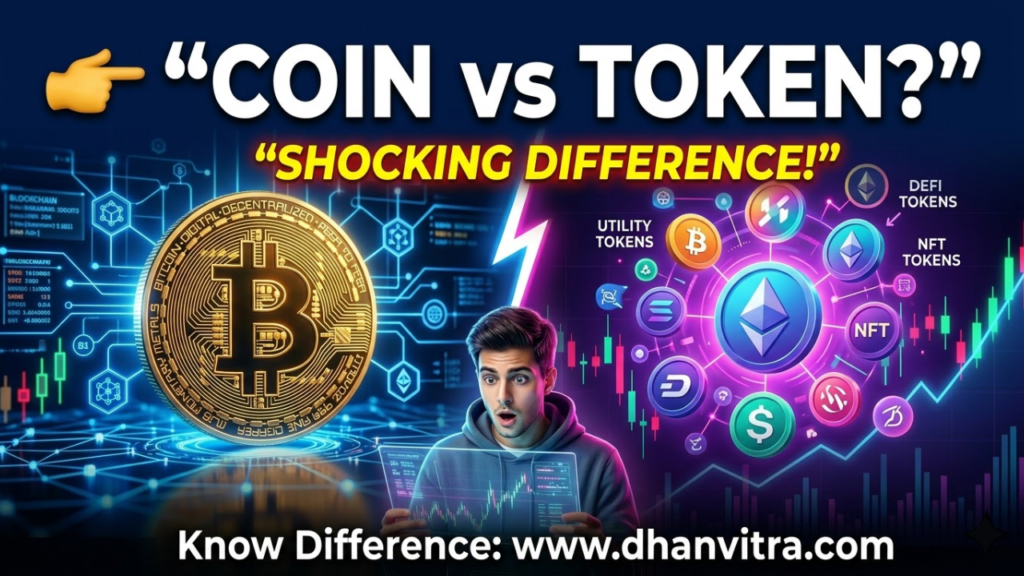
If you’re searching for a beginner-friendly guide to crypto basics for trading, you’re in the right place. At Dhanvitra, we simplify complex topics so you can make smarter decisions in the fast-moving world of digital assets. Cryptocurrency may look confusing at first, but once you understand the foundation, everything starts to click. Whether you want to invest, trade, or just stay updated with trending tech topics, learning the difference between a coin and a token is your first step. Many new traders jump in without this knowledge and end up making costly mistakes. That actually helps you grow.
When we talk about what cryptocurrency is for beginners, think of it as digital money that runs on blockchain technology. A blockchain is a public ledger that records every transaction securely and transparently. Now, here’s where it gets interesting—there are two main types of crypto assets: coins and tokens. It works like real money. You can use it to store value or send payments. On the other hand, a token is built on an existing blockchain. It represents something else, like access to a service, voting rights, or even digital ownership. Understanding this basic structure helps you avoid confusion when exploring new projects.
Let’s make it even clearer with a coin vs token real-world example for beginners. Imagine a shopping mall. The mall itself is the blockchain. The official currency accepted everywhere in the mall is like a coin. But now, think about gift cards, loyalty points, or coupons used in specific stores inside the mall—those are tokens. They depend on the mall’s system to work. In crypto, tokens rely on existing blockchains like Ethereum to function. This simple analogy helps you instantly understand why coins and tokens are not the same, even though both are part of the crypto ecosystem.
From a trading perspective, knowing the difference between coin and token for investment strategy can directly impact your profits. Coins are often seen as more stable because they power their own networks. Tokens, however, can offer higher growth potential because they are tied to specific projects like DeFi platforms, gaming apps, or AI-based systems. Many scam projects also launch tokens, so doing proper research is critical. This is where platforms like Dhanvitra help by providing reliable insights, trending analysis, and easy-to-understand guides that keep you ahead in the market.
So, what’s the takeaway from this crypto basics guide for global beginners? Don’t treat all cryptocurrencies the same. Coins and tokens serve different purposes, and understanding that difference gives you a strong edge. Start small, stay curious, and always verify before investing. With the right knowledge and a trusted resource like Dhanvitra, you’re not just following trends—you’re making informed decisions in one of the most exciting tech spaces today.
Why Understanding Coin vs Token Matters
The crypto market moves fast, and small mistakes can cost real money. Many new traders still confuse coin vs token, and that confusion leads to poor decisions. When you know the difference, you start to see the market more clearly. You stop chasing hype and begin making smart, calculated moves.
The rise of DeFi, Web3, and AI-based crypto projects has changed how people invest. Most new projects launch as tokens, not coins. If you treat every crypto asset like a coin, you might misunderstand its value and purpose. That can lead to buying into projects that have no real long-term use.
Understanding this difference also helps you avoid scams. Many fake projects use fancy words to look like real coins. But in reality, they are just tokens with no strong foundation. When you know what to look for, you can protect your money and trade with more confidence.
Think of it like driving a car. You don’t need to know everything about the engine, but you must know the basics to avoid accidents. The same applies to crypto. Once you understand coins and tokens, you gain control over your trading journey.
What is a Coin in Cryptocurrency?
A cryptocurrency coin is a digital asset that runs on its own blockchain. It does not depend on any other network to exist. Coins are like the main currency of a system, just like dollars or euros in the real world. They are used for payments, storing value, and sometimes even for building entire financial systems.
Coins have a strong foundation because they operate on their own blockchain technology. This means they control their own rules, security, and transactions. For example, when you send a coin from one wallet to another, the transaction is verified on its native blockchain. This gives coins a higher level of independence compared to tokens.
Another important point is that coins often act as store-of-value assets. Many investors treat them like digital gold. They hold coins for the long term, hoping their value will grow over time. This is why coins are often less risky than tokens, though they still carry market risks.
In simple terms, if a crypto asset has its own blockchain, it is a coin. This makes it easier to identify. Once you understand this rule, you can quickly separate coins from tokens in most cases.
What is a Token in Cryptocurrency?
A crypto token is very different from a coin. It does not have its own blockchain. Instead, it is built on top of an existing blockchain like Ethereum or Binance Smart Chain. Tokens use the infrastructure of these networks to function.
Tokens are more flexible and creative. They can represent many things, such as access to a service, voting rights, or even digital ownership. For example, in DeFi and NFT ecosystems, tokens are used to power apps, games, and online platforms. This is why you see so many new tokens launching every day.
One key feature of tokens is that they are easier to create. Developers do not need to build a new blockchain from scratch. They can simply create a token using smart contracts. This lowers the entry barrier and leads to a huge number of tokens in the market.
But this also comes with risks. Since tokens are easy to create, many low-quality or fake projects exist. Some tokens have no real use case. Others disappear after the hype fades. That’s why traders must research before investing in any token.
Core Difference Between Coin vs Token
The main difference between a coin and a token lies in their foundation. A coin runs on its own blockchain, while a token relies on another blockchain. This single difference changes everything, from how they work to how they gain value in the market.
Coins are often used as money. They are designed for transactions, payments, and storing value. Tokens, on the other hand, are more like tools inside a system. They can represent assets, access rights, or even governance power in a project. This makes tokens more versatile but also more complex.
Another big difference is in security and control. Coins manage their own network, so they have full control over their operations. Tokens depend on the blockchain they are built on. If that blockchain faces issues, the tokens may also be affected.
From an investment point of view, coins are often seen as safer long-term assets. Tokens can offer higher returns, but they come with higher risk. If you want stability, coins may suit you better. If you want growth and innovation, tokens might be more exciting.
Coin vs Token Comparison Table
Let’s make this super clear in a way that sticks in your mind. When you hear the terms “coin vs token difference for beginners” or “crypto coin vs token explained simply,” what you really need is clarity, not confusion. A coin is native to its own blockchain, while a token lives on top of an existing one. That single idea changes everything about how they work, how they gain value, and how traders use them in real markets. If you don’t get this part right, you might invest in something without even knowing its true purpose.
Here’s a clean comparison that helps you instantly understand the difference:
| Feature | Coin | Token |
|---|---|---|
| Blockchain | Has its own blockchain | Built on existing blockchain |
| Purpose | Digital money or store of value | Utility, governance, or asset |
| Examples | Bitcoin, Ethereum | USDT, UNI, LINK |
| Creation | Requires building a blockchain | Easy to create using smart contracts |
| Use Case | Payments, fees, security | Apps, DeFi, NFTs, voting |
Now think about it like this: coins are like owning land, while tokens are like building apps or businesses on that land. You wouldn’t treat them the same, right? That’s exactly how traders should think. When people search for “which is better, coin or token for investment,” the real answer depends on your goal. Coins often bring stability, while tokens bring opportunity—and sometimes higher risk.
Another key difference that many miss is scalability. Coins are harder to create, so they often carry more trust and long-term value. Tokens, on the other hand, can explode overnight because they are easier to launch. That’s why you see so many trending searches like best new crypto tokens or high-growth DeFi tokens. The opportunity is huge, but so is the volatility. Understanding this table is not just theory—it’s your edge in the market.
Bitcoin vs USDT Case Study
Let’s bring this concept to life with a real-world example that every trader should understand. When people search for Bitcoin vs USDT difference or coin vs stablecoin explained, they are really trying to see how these assets behave in real trading situations.
Bitcoin is a coin. USDT is a token. That’s the foundation. Bitcoin runs on its own blockchain and acts as a store of value, often called “digital gold.” Its price moves based on demand, market sentiment, and macro trends. On the other hand, USDT (Tether) is a token built on multiple blockchains like Ethereum and Tron. Its value is pegged to the US dollar, which means it stays close to $1 almost all the time.
Now imagine you are trading. When the market is going up, you might hold Bitcoin to make profits. When the market becomes unstable, you might move your funds into USDT to protect your capital. This is why traders often search for how to use USDT in crypto trading or the best stablecoins for beginners. One asset grows your money, while the other protects it.
The difference also shows in risk. Bitcoin can go up or down quickly, which makes it exciting but unpredictable. USDT stays stable, but it depends on trust in the issuer. So when someone asks, Should I invest in Bitcoin or USDT? The better question is, What is my goal right now—growth or safety?
Why Traders Must Understand This Difference
If you’re serious about crypto, you cannot ignore the importance of coin vs token in trading. This is not just a technical detail—it directly affects your profits, risks, and strategy. Many beginners jump into trending tokens without even knowing what they are buying. That’s like driving a car without knowing where the brakes are. It might work for a while, but eventually, it leads to trouble.
Understanding this difference helps you make smarter decisions. Coins are often used for long-term investing because they have stronger foundations. Tokens, especially in areas like DeFi and NFTs, are more flexible and can grow faster. That’s why people search for the best crypto investment strategy or long-term vs short-term crypto assets. Each type plays a different role in your portfolio.
There’s also a huge risk factor involved. Many scam projects launch tokens because they are easy to create. If you don’t know how tokens work, you might fall for hype instead of value. Knowing the difference helps you ask the right questions: Does this token have a real use case? Is it solving a problem? Or is it just another pump-and-dump scheme?
At the end of the day, this knowledge gives you control. Instead of following trends blindly, you start thinking like a strategist. And that’s where real money is made—not in guessing, but in knowing.
Latest Trends in Coins and Tokens
The crypto world is moving fast, and if you’re not keeping up with the latest crypto trends, coins, and tokens, you’re already behind. One of the biggest shifts right now is the rise of real-world utility tokens. These are not just hype projects—they are connected to actual services like finance, gaming, and even AI. People are actively searching for top utility tokens with real use cases, because they want more than just speculation.
Another major trend is the explosion of DeFi tokens. Decentralized finance is no longer a niche—it’s becoming mainstream. Tokens are now powering lending, borrowing, staking, and even insurance systems. When you search for the best DeFi tokens to invest in, you’ll notice that these tokens are deeply integrated into financial ecosystems. They are not just assets—they are tools.
Meme tokens are also evolving. Earlier, they were mostly jokes, but now some of them are building real communities and utilities. That’s why keywords like next 100x meme coin are trending globally. While risky, these tokens attract massive attention and liquidity. Smart traders don’t ignore them—they study them carefully.
Finally, coins are becoming more institutional. Big companies and even governments are exploring blockchain-based currencies. This adds credibility and stability to coins compared to tokens. So when you think about the future of cryptocurrency coins vs tokens, the reality is this: coins are becoming stronger foundations, while tokens are becoming innovative layers on top. And if you understand both, you position yourself ahead of 90% of traders in the market.
Coin vs Token: Which is Better for Investment?
Choosing between a coin and a token for investment can feel confusing at first, especially when both seem to offer high returns. But the truth is simple—your choice depends on your goal. If you are looking for stability and long-term growth, coins often stand stronger because they run on their own blockchain. Coins like Bitcoin or Ethereum are not just digital assets; they are entire ecosystems. That gives them more trust, wider adoption, and stronger long-term value in the global crypto market.
Now let’s talk about tokens. Tokens are more flexible and often more exciting, especially for short-term gains. Many trending tokens are part of DeFi projects, gaming platforms, and AI-based ecosystems. These tokens can grow fast because they ride on popular blockchains like Ethereum or Binance Smart Chain. But here’s the catch—tokens depend on another blockchain, which means their value can rise quickly but also fall just as fast. It’s like investing in a startup versus investing in a well-established company.
If you think like a smart investor, you won’t pick just one side. A balanced strategy often works best. Coins can act as your “safe zone,” while tokens can be your “growth boosters.” For example, you might hold coins for long-term wealth building and use tokens for short-term trading opportunities. This mix helps reduce risk while still giving you a chance to catch trending crypto profits.
So, which is better? There is no one-size answer. If you want low risk and long-term crypto investment, go for coins. If you want high risk and fast returns, tokens might suit you better. The smartest move is to understand both and build a strategy that matches your risk level and financial goals.
Beginner Mistakes to Avoid
When beginners enter the crypto market, they often make simple mistakes that can cost them a lot of money. One of the biggest errors is assuming that every crypto asset is the same. Many new traders don’t understand the difference between coins and tokens, and they invest blindly based on hype. This is dangerous because not all projects have real value. Some tokens are created just to attract attention and disappear later.
Another common mistake is chasing trending tokens without research. You might see a token going viral on social media and feel the urge to invest quickly. But ask yourself—does this project have a real use case? Does it solve a problem? If not, you are just gambling, not investing. Smart traders always look beyond the hype and check the fundamentals before putting their money in.
Security is another area where beginners struggle. Many people invest in unknown tokens without checking if they are safe. Scams and rug pulls are still common in the crypto world, especially with new tokens. Always verify the project’s website, team, and smart contract details before investing. If something feels too good to be true, it usually is.
Finally, beginners often invest more than they can afford to lose. Crypto is highly volatile, and prices can change in seconds. A smart rule is to only invest what you are comfortable losing. Start small, learn the market, and grow gradually. This mindset will protect you from emotional decisions and help you become a better trader over time.
Conclusion
Understanding the difference between coin and token is not just a technical detail—it’s a powerful tool for smarter investing. When you know how each works, you can make better decisions and avoid unnecessary risks. Coins offer stability and long-term growth, while tokens bring innovation and high-return opportunities. Both have their place in a well-planned crypto portfolio.
The crypto world is evolving fast, and new projects are launching every day. That’s why knowledge becomes your biggest advantage. Instead of following the crowd, you can analyze projects with clarity and confidence. This gives you an edge that most beginners don’t have.
Think of crypto investing like building a strong house. Coins are your foundation, and tokens are your design and expansion. Without a strong base, your structure won’t last. But without innovation, it won’t grow either. Balance is the key to long-term success in this space.
If you stay curious, keep learning, and avoid common mistakes, you can turn crypto from a risky game into a smart financial opportunity. The difference between winning and losing often comes down to understanding simple concepts—just like coin vs token.
FAQs
What distinguishes a coin from a token?
A coin operates on its own blockchain, while a token is built on an existing blockchain. This means coins have their own independent network, while tokens depend on another platform like Ethereum. Coins are often used as digital money, while tokens can represent assets, utilities, or even voting rights. Understanding this difference helps you make better investment decisions in the crypto market.
Are tokens riskier than coins?
In most cases, yes. Tokens can be riskier because they depend on another blockchain and are often part of new or experimental projects. Many tokens are created quickly, and not all have strong fundamentals. This makes them more volatile compared to established coins. However, higher risk also brings the possibility of higher rewards.
Can tokens become coins in the future?
Yes, it is possible. Some projects start as tokens and later develop their own blockchain, turning into coins. This process is called a “mainnet launch.” When this happens, the project gains more control and independence. It can also increase trust and long-term value in the market.
Which is better for beginners: coins or tokens?
Coins are usually better for beginners because they are more stable and widely accepted. They have a proven track record and lower risk compared to new tokens. Starting with coins helps you understand the market before exploring more complex investments like tokens.
How can I select the top cryptocurrency for investment?
Start by researching the project’s purpose, team, and technology. Look for real-world use cases and strong community support. Avoid investing based only on hype or social media trends. A smart approach is to diversify your portfolio with both coins and tokens while managing your risk carefully.